
Mojtaba Dashti · Digital Marketing · AI Search
Google Is Changing Shopping: Will Iranian Businesses Be Visible in AI Search?
What Google Universal Cart means for Iranian manufacturers, AI-powered discovery, and practical SEO, GEO and AEO work for B2B buyer acquisition.

From Google Universal Cart to the challenge of making Iranian manufacturers discoverable in ChatGPT and intelligent search
For years, online shopping usually began with a search, a series of websites and a comparison of prices. AI assistants are changing that sequence: a buyer can describe a need in everyday language, compare suggestions and sometimes move closer to checkout without visiting every seller directly. Google’s Universal Cart announcement is part of this wider change.
The practical question for Iranian businesses is not whether every sale will happen inside Google. It is this: if a buyer asks an AI service to find a suitable supplier, will that company be discoverable and credible?
1. What is Universal Cart and what might change?
Google announced Universal Cart earlier in 2026 and began rolling out the shopping feature in the United States in October 2026, according to its product announcement. It lets people organize items from multiple stores in one shopping flow, with support for tracking price changes and availability. Supported checkout experiences may differ by merchant: in some cases an order is completed in a Google flow; in others the buyer proceeds to the merchant’s own site. Sellers still carry commercial responsibilities such as fulfilling the order and serving the customer.
It would be misleading to claim that all store websites are becoming obsolete. The deeper change is where customers begin comparing options, how decisions are supported and which information is visible before a site visit.
2. What does this mean for businesses in Iran?
Universal Cart was not announced as a general checkout service for Iranian shoppers. Google services also have different country restrictions. Merchant Center access for businesses based in Iran is restricted under Google’s rules; that is not the same as claiming every Iranian website is excluded from ordinary web search or AI-generated answers.
Separate direct participation in Google’s shopping ecosystem from being discoverable through publicly accessible, accurate company and product information. For many Iranian manufacturers, the second question is the immediate commercial priority.
3. Why are some company websites hard to discover?
Several recurring issues weaken the usefulness of otherwise valuable industrial websites. Product specifications may exist only inside a PDF catalog. Pages may list codes and dimensions without explaining applications, compatibility or the buyer’s problem. Company names, services and contact details can be inconsistent across channels. Pages can also have crawling or indexing problems, and foreign-language descriptions may be thin or poorly localized.
A buyer who searches for 'hardware for a heavy window sash' may not know an exact product code. An effective page should explain the real application, limits and selection criteria as well as specifications. Good content improves decision-making, not just rankings.
4. Do websites need a direct connection to ChatGPT or Gemini?
No general plugin or one-off connection guarantees inclusion in AI search. Search engines and assistants use public pages and other sources according to their own retrieval and eligibility rules. Google says its AI search experiences do not require a separate set of special technical requirements beyond the fundamentals of Search.
SEO helps engines access and understand pages. AEO focuses on answering buyers’ real questions accurately. GEO is a useful label for improving clarity, factual grounding and quotability in generative search. These approaches overlap; none can guarantee that an AI system will recommend a particular business.
5. A real example from Iran Leather Connect
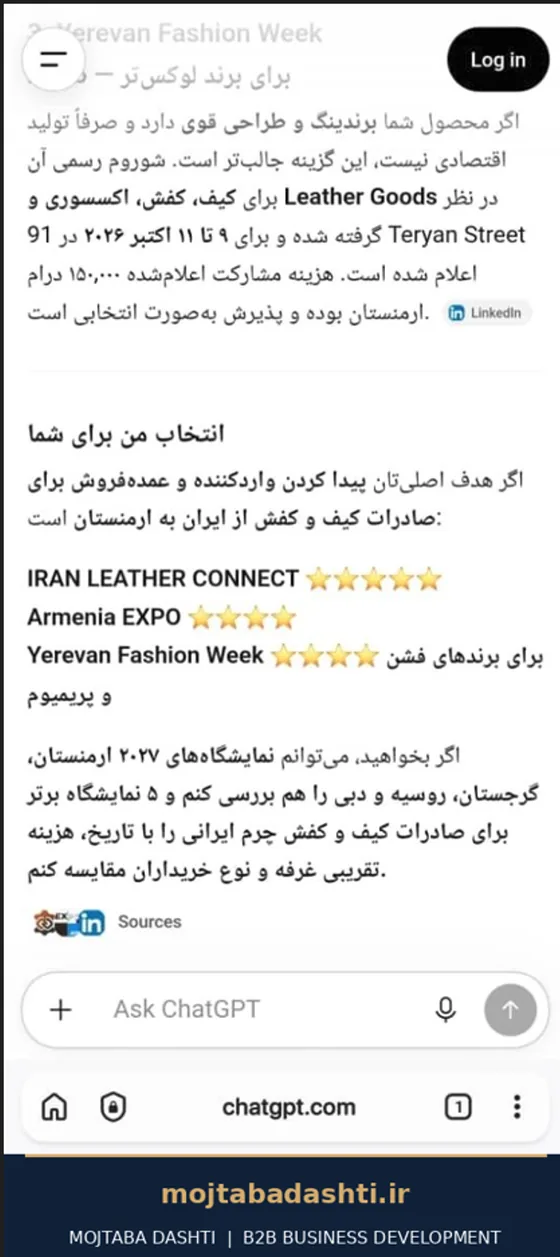
In one ChatGPT conversation about trade-event options for Iranian leather and footwear exporters looking toward Armenia, the name Iran Leather Connect appeared among suggested events. This is a useful illustration of how AI can introduce a business or event during early research. It is not proof of a permanent rank, an endorsement or that every generated fact was correct. The answer might change with the user’s question or the time of the search.
That uncertainty is another reason to maintain accessible, up-to-date and verifiable information about a company and its activity.
6. Where does B2B selling fit into this change?
Universal Cart currently relates more directly to consumer shopping than to complex industrial procurement. B2B purchasing still requires fit checks, capacities, commercial terms, freight, sample approval, technical discussion and negotiation. But AI may increasingly help buyers create a shortlist of suppliers before contacting anyone.
Imagine a purchasing manager asking: 'Which suppliers can provide this component, and how do their specifications, applications and delivery conditions differ?' A company with useful product pages is easier to evaluate, although final trust still requires real communication, evidence and follow-up.
7. Six practical steps for Iranian companies
First, investigate the questions customers actually ask. Second, publish independent product and service pages with applications, specifications, limitations, real images and a clear contact route. Third, check crawling, indexing, sitemaps, internal links and appropriate structured data. Fourth, keep company identity consistent and support claims with attributable experience or published projects. Fifth, design an inquiry process that turns interest into a real technical or commercial conversation. Sixth, measure actual outcomes: search appearances, relevant visits, inquiries and qualified sales opportunities.
Avoid expensive 'guaranteed rankings in ChatGPT' offers. Focus on the accuracy, usefulness and accessibility of business information.
8. Digital presence and B2B sales must reinforce each other
A polished website cannot replace the team that qualifies inquiries and follows up on proposals. Nor can a strong sales team fully compensate for unclear product information online. The two efforts need to reinforce one another, from market research and customer identification to inquiry handling and commercial follow-up.
Conclusion: discoverability is only the beginning
AI may change where buyers discover suppliers, but it does not remove the need to establish trust. The important goal is not to mention AI more often; it is to present credible information, solve valuable customer problems and build a follow-up process that turns curiosity into business.
If a buyer asks an AI assistant to recommend suppliers in your industry today, what trustworthy information will it find about your company?
Sources
Related:
Iran–Armenia market entry • B2B Sales Psychology • Books to Business •
On this page
- 1. What is Universal Cart and what might change?
- 2. What does this mean for businesses in Iran?
- 3. Why are some company websites hard to discover?
- 4. Do websites need a direct connection to ChatGPT or Gemini?
- 5. A real example from Iran Leather Connect
- 6. Where does B2B selling fit into this change?
- 7. Six practical steps for Iranian companies
- 8. Digital presence and B2B sales must reinforce each other
- Conclusion: discoverability is only the beginning
- Sources
