
Why do B2B quotations fail to turn into orders?
A practical guide for manufacturers and sales managers: diagnose the stalled deal before discounting or calling again.

The short answer: a quotation is not a confirmed sales opportunity
Sending a quotation does not mean an order is imminent. Some buyers are budgeting or benchmarking suppliers; others still need technical or financial approval. Identify where the opportunity stalled before choosing the next action.
Before preparing a proposal, clarify the product specification, intended application, purchasing timeframe and decision process. Silence is not proof that your price is too high.
Seven reasons a quote goes nowhere
1. The requirement was not qualified
A product name alone may not establish compatibility. Capture the relevant system, dimensions, application and constraints in a category-specific checklist.
2. The quote communicates price but not value
Include correct product codes, quantities, scope, lead time, validity and service terms so stakeholders can compare offers without guesswork.
3. Your response misses the buyer’s timetable
Track enquiry receipt, information completion and quote issue separately. An urgent project and a future budgeting exercise need different handling.
4. The decision process is unclear
Purchasing, engineering, project management and finance may all be involved. Respect the formal buying process and ask which information each stakeholder needs.
5. Commercial terms do not fit
Availability, minimum quantities, payment, freight or delivery may stop an otherwise acceptable offer. Diagnose the objection before offering a discount.
6. Follow-up has no agreed purpose
Instead of repeatedly asking whether the customer will buy, confirm receipt, address technical questions and agree on the next review date.
7. Lost opportunities are not classified
“No purchase” is not useful management data. Record a primary reason such as price, specification, lead time, supply, project delay or another supplier.

An industrial example
A window manufacturer sends drawings to a hardware supplier. The sales team checks the components and issues a quotation. A lack of response might mean pending technical approval, competitor comparison, a shifted project schedule or an internal purchasing delay. These require different follow-ups.
This illustrates a common workflow; it is not an invented client performance claim.
What sales managers should measure
Keep enquiries, qualified enquiries, quotations, confirmed orders, response time, quote value and order value separate. Log the reason when a deal does not progress.
Count-based quote-to-order conversion = quotations converted to orders ÷ quotations with a resolved outcome × 100. Do not treat open quotations as lost or confuse count conversion with value conversion.
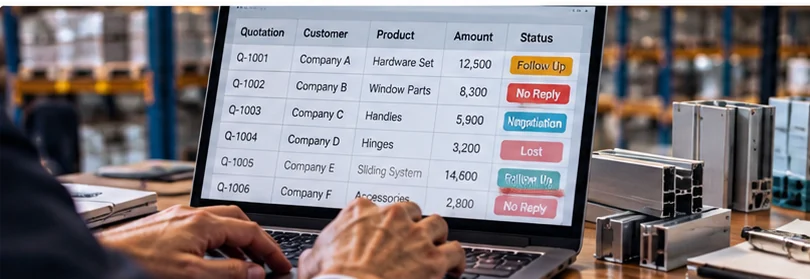
A seven-point quotation review
Was receipt confirmed? Is the technical requirement documented? Are price, payment and delivery clear? Do you know the approval process? Have objections been clarified? Is there an agreed next step? Is the latest contact recorded?
Do you need a CRM?
Define stages, ownership and the minimum useful data first. Software cannot repair an undefined sales process. For the stage before quoting, see the linked guide to finding new industrial B2B customers.
Frequently asked questions
When should we follow up?
There is no universal number of days. Agree on the review date based on urgency and the buyer’s purchasing cycle.
Will a discount improve conversion?
Only if price is the real obstacle. Compatibility, stock and delivery cannot always be solved through lower prices.
How do we distinguish price from process problems?
Compare documented feedback, response times and commercial terms instead of drawing conclusions from a single objection.
What is the difference between an enquiry and a qualified opportunity?
An enquiry asks for information; a qualified opportunity has been checked for need, fit and purchasing potential.
Next step
If enquiries are arriving but orders are limited, assess the sales workflow before spending more on advertising. Mojtaba Dashti’s B2B sales development service in Iran explains the approach.
Discuss the next step for your business
Share your product or service, target customer and current challenge so we can assess the fit and a relevant next step.
On this page
- The short answer: a quotation is not a confirmed sales opportunity
- Seven reasons a quote goes nowhere
- 1. The requirement was not qualified
- 2. The quote communicates price but not value
- 3. Your response misses the buyer’s timetable
- 4. The decision process is unclear
- 5. Commercial terms do not fit
- 6. Follow-up has no agreed purpose
- 7. Lost opportunities are not classified
- An industrial example
- What sales managers should measure
- A seven-point quotation review
- Do you need a CRM?
- Frequently asked questions
- When should we follow up?
- Will a discount improve conversion?
- How do we distinguish price from process problems?
- What is the difference between an enquiry and a qualified opportunity?
- Next step
